
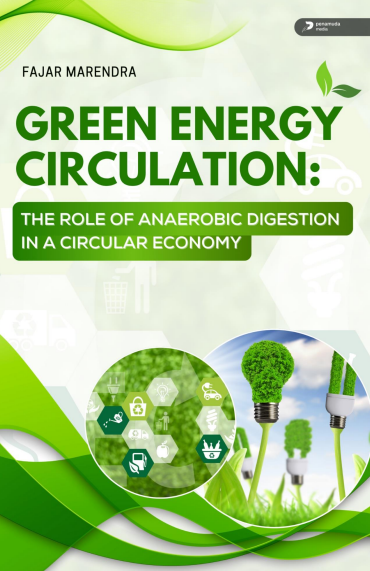
GREEN ENERGY CIRCULATION: The Role of Anaerobic Digestion in a Circular Economy
Rp210.000 Original price was: Rp210.000.Rp150.000Current price is: Rp150.000.
Penulis :
Fajar Marendra S.T., M.Sc
ISBN : 978-634-7431-19-6
Jumlah Hlm : x + 225
Ukuran : 15 x23 Unesco
Kertas : Bookpaper
Tahun Terbit : 2025
Editor : –
SINOPSIS
Amidst environmental crises, soaring waste levels, and global dependence on fossil fuels, this book emerges as a significant contribution to redefining the path of sustainable development. Green Energy Circulation provides a comprehensive discussion on how Anaerobic Digestion (AD) technology can serve as a strategic solution for advancing the circular economy and transitioning towards a cleaner, more efficient energy system. Employing a scientific yet accessible approach, the author outlines the fundamental principles of the circular economy, the biochemical mechanisms of the anaerobic process, the potential of biogas and biofertilizer, and how AD technology can transform organic waste into high-value resources. Furthermore, the book presents global case studies from countries like Germany, Sweden, India, and Brazil, which have successfully implemented AD on a massive scale. The author emphasizes the critical importance of integrating the latest technologies such as the Internet of Things (IoT), artificial intelligence (AI), and circularity-based business models as keys to the successful implementation of AD, from household to industrial scales. Critical issues such as regulatory challenges, financing, public education, and cross-sector collaboration are also discussed in depth. This book is highly relevant for students, researchers, policymakers, environmental activists, and renewable energy practitioners. With a reflective yet data-driven presentation style, this book not only offers theoretical insights but also provides a practical roadmap for building a resilient and inclusive circular energy ecosystem for the future.
Daftar Isi
FOREWORD v
TABLE OF CONTENTS vi
CHAPTER 1: THE MODERN-DAY ENVIRONMENTAL AND ENERGY CRISIS 1
- The Pros and Cons of Electric Vehicles: Solution or New Threat? 1
- The Battery Waste Dilemma in the Energy Transition Era 18
- Renewable Energy’s Continued Dependence on Fossil Fuels 23
CHAPTER 2 GLOBAL WASTE: EXPORTS, IMPORTS, AND INDONESIA’S DILEMMA 26
- Global Waste Export and Import: Between Economic Interests and Environmental Ethics 26
- The Disarray of Indonesia’s Domestic Waste Management 33
- Regional Inequality and Reliance on Instant
Solutions 38
CHAPTER 3 THE URGENCY OF A NEW PARADIGM: TOWARDS A CIRCULAR ECONOMY 44
- The Failure of the Linear Paradigm: Produce–Consume–Discard 44
- The Circular Economy as a Systemic Alternative 49
- The Relevance of the Circular Economy in the Indonesian Context 54
CHAPTER 4 BASIC CONCEPTS OF THE CIRCULAR ECONOMY 59
- Background and Urgency of the Circular Economy in the Global Context 59
- Comparison of Linear Economy vs. Circular
Economy 64 - Implications of the Circular Economy for Waste and Energy Management 69
- The Role of Technology in Driving the Transition to a Circular Economy 73
CHAPTER 5 ANAEROBIC DIGESTION: PROCESS AND POTENTIAL 77
- Understanding Anaerobic Digestion 77
- Biochemical Mechanism of the Anaerobic Process 81
- Stages of the Anaerobic Digestion Process 85
- Factors Influencing Process Efficiency 89
- Anaerobic Digestion Products: Biogas and Biofertilizer 106
CHAPTER 6 INTEGRATION OF ANAEROBIC DIGESTION IN THE CIRCULAR ECONOMY 111
- Organic Waste as a Source of Renewable Energy 111
- Biogas in the Green Energy Scheme and Energy Decentralization 115
- Biofertilizer: Contribution to Sustainable
Agriculture 119 - Biogas Value Chain in the Circular Economy 122
CHAPTER 7 ENVIRONMENTAL AND SOCIO-ECONOMIC BENEFITS 128
- Reduction of Greenhouse Gas Emissions 128
- Conservation of Natural Resources 133
- Improvement of Local Community Welfare 136
D. Creation of Green Jobs 140
CHAPTER 8 CHALLENGES OF ANAEROBIC DIGESTION IMPLEMENTATION 144
- Technological and Infrastructure Constraints 144
- Economic and Financing Challenges 146
- Regulations and Policies 148
- Social Acceptance and Public Education 149
CHAPTER 9 CASE STUDIES AND BEST PRACTICES 151
- Biogas Implementation in Europe 151
- Biogas Programs in Asia and Latin America 153
- Comparative Analysis: Success and Failure
Factors 154 - Lessons for Future Development 156
CHAPTER 10: FUTURE DIRECTIONS AND OPPORTUNITIES 162
- Anaerobic Digestion Technology Innovations 163
- Biogas Integration with Smart Grids and IoT 166
- The Role of Anaerobic Digestion in the Net Zero Emissions Agenda 170
- Strategic Recommendations for Strengthening the Circular Energy System 173
CHAPTER 11 SUPPORTING TECHNOLOGIES AND RECENT INNOVATIONS IN ANAEROBIC DIGESTION SYSTEMS 179
- Integration of IoT and Smart Sensor Technology in Anaerobic Reactors 179
- Utilization of Bioengineered Microorganisms for High Methane Production 183
- Biogas Purification Technology: Upgrading and Enrichment 187
D. New Generation Reactors: Modular, from Household to Industrial Scale 191
- AI and Machine Learning-Based AD Process Modeling and Simulation 195
CHAPTER 12 POLICY STRATEGIES AND BUSINESS MODELS TO PROMOTE THE APPLICATION OF ANAEROBIC DIGESTION 199
- Global Policy Analysis: Lessons from the European Union, China, and the US 199
- National Policy and Regulatory Reform Recommendations in Indonesia 203
- Financing Schemes and Economic Incentives 207
- Circular Business Models in AD: From Waste to Economic Value 211
- Implementation Strategy in the Regions: Collaboration between Local Government, Academia, and Community 214
REFERENCES 219
ABOUT THE AUTHOR 225
Produk Serupa
Related products
-
Sale!
MANAJEMEN UMKM
Rp98.000Original price was: Rp98.000.Rp80.000Current price is: Rp80.000. -
Sale!

PEMBANGUNAN SMART CITY Pendekatan Integrasi Teknologi Informasi
Rp98.000Original price was: Rp98.000.Rp80.000Current price is: Rp80.000. -
Sale!
MANAJEMEN PROYEK
Rp98.000Original price was: Rp98.000.Rp80.000Current price is: Rp80.000. -
Sale!

IT GOVERNANCE
Rp98.000Original price was: Rp98.000.Rp80.000Current price is: Rp80.000. -
Sale!
CLOUD COMPUTING
Rp98.000Original price was: Rp98.000.Rp80.000Current price is: Rp80.000. -
Sale!

E-COMMERCE
Rp98.000Original price was: Rp98.000.Rp80.000Current price is: Rp80.000.