Penulis :
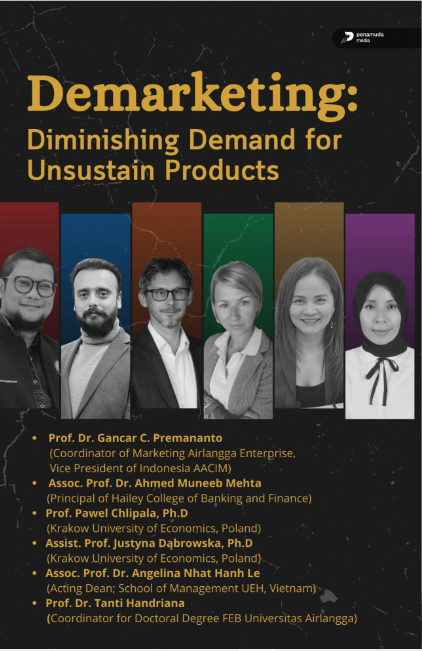
Prof. Dr. Gancar C. Premananto
Assoc. Prof. Dr. Ahmed Muneeb Mehta
Prof. Pawel Chlipala, Ph.D
Assist. Prof. Justyna Dąbrowska, Ph.D
Assoc. Prof. Dr. Angelina Nhat Hanh Le
Prof. Dr. Tanti Handriana
ISBN : 978-634-283-088-8
Jumlah Hlm : x + 173
Ukuran : 15 x23 Unesco
Kertas : Bookpaper
Tahun Terbit : 2026
Editor : –
SINOPSIS
Demarketing: Diminishing Demand for Unsustainable Products presents a comprehensive and critical exploration of demarketing as a strategic, ethical, and policy-oriented approach to addressing the global crisis of unsustainable consumption. The book traces the evolution of the demarketing concept and situates it within marketing science, consumer behavior studies, and public policy frameworks, emphasizing its relevance in reducing demand for products that generate significant social, environmental, and economic harm. Through systematic discussions of unsustainable products, consumerist culture, and the life-cycle impacts of goods, the book demonstrates how demand is socially constructed and can therefore be intentionally reshaped. It examines a wide range of demarketing strategies and instruments including pricing mechanisms, environmental taxation, regulatory restrictions, public communication, and negative incentives while critically assessing consumer resistance, ethical dilemmas, and social justice implications, particularly in developing countries. Drawing on global case studies such as tobacco control, single-use plastics, fossil energy, and health-hazardous products, the book highlights both the challenges and opportunities of implementing demarketing in diverse institutional contexts.
Daftar Isi
Preface …………………………………………………………………………………….. v
Table of Content ………………………………………………………………….. vii
CHAPTER I The Evolution of the Demarketing Concept…1
A. The History and Development of Demarketing
Theory …………………………………………………………………………….2
B. Demarketing from a Marketing Science
Perspective…………………………………………………………………. 11
C. Distinguishing Demarketing, Social Marketing, and
Green Marketing ……………………………………………………….. 16
D. Demarketing as a Public Policy Instrument …………. 20
CHAPTER II Unsustainable Products and Demand
Patterns ………………………………………………………………………………… 25
A. Definition and Criteria of Unsustainable Products 26
B. Product Life Cycles and Environmental
Footprints …………………………………………………………………… 33
C. Consumer Behavior toward Unsustainable
Products ……………………………………………………………………… 37
D. The Role of Advertising and Consumerist Culture 41
E. Social, Economic, and Ecological Impacts …………….. 44
CHAPTER III Demarketing Strategies and Instruments 48
A. Demarketing through Pricing and Environmental
Taxes……………………………………………………………………………. 49
B. Demarketing through Distribution Control and
Access Restrictions …………………………………………………… 52
C. Demarketing through Communication and Public
Information ………………………………………………………………… 55
D. Regulation, Prohibition, and Product Standards …. 58
E. Policy Innovation through Negative Incentive–
Based Demarketing…………………………………………………… 62
CHAPTER IV Demarketing and Consumer Behavior…….. 65
A. Consumer Psychology in the Context of Demand
Reduction……………………………………………………………………. 66
B. Consumer Resistance to Demarketing Policies …… 69
C. The Role of Social Norms and Consumption
Ethics …………………………………………………………………………… 73
D. Consumer Education and Sustainability Literacy .. 76
E. Behavioral Change as a Long-Term Objective ……… 79
CHAPTER V Demarketing in Global Practice ………………… 80
A. Case Studies of Demarketing in Tobacco Products81
B. Demarketing of Single-Use Plastics ……………………….. 84
C. Demarketing of Fossil Energy and Carbon-Based
Products ……………………………………………………………………… 90
D. Restricting the Consumption of Health-Hazardous
Products ……………………………………………………………………… 93
E. Lessons Learned from International Experiences . 96
CHAPTER VI Demarketing in Developing Countries …….. 99
A. Challenges of Demarketing in Developing
Countries ………………………………………………………………….. 100
B. Social Justice Dimensions of Demarketing ………… 103
C. Demarketing and Community Economic
Resilience …………………………………………………………………. 105
D. The Role of Government, the Private Sector, and
Civil Society ……………………………………………………………… 108
E. Local Contexts and Policy Adaptation ………………… 111
CHAPTER VII Demarketing, Business, and Corporate
Responsibility……………………………………………………………………. 114
A. Sustainable Business Paradigms …………………………. 115
B. Corporate Social Responsibility and
Demarketing ……………………………………………………………. 117
C. Ethical Dilemmas in Corporate Demarketing
Practices …………………………………………………………………… 121
D. Business Model Transformation from Products to
Solutions ………………………………………………………………….. 125
E. The Role of Innovation and Technology …………….. 128
CHAPTER VIII Demarketing within the Public Policy
Framework ………………………………………………………………………… 132
A. Demarketing as an Environmental Policy
Instrument ………………………………………………………………. 133
B. Integrating Demarketing into Development
Policies ……………………………………………………………………… 140
CHAPTER IX The Future of Demarketing and Global
Sustainability …………………………………………………………………….. 145
A. Demarketing within the SDGs Agenda ……………….. 146
B. Transforming Production and Consumption
Patterns ……………………………………………………………………. 150
C. Global Challenges and Innovation Opportunities 154
D. Toward a Circular and Low-Carbon Economy ….. 158
Reference …………………………………………………………………………… 163
About the Authors ……………………………………………………………. 167