
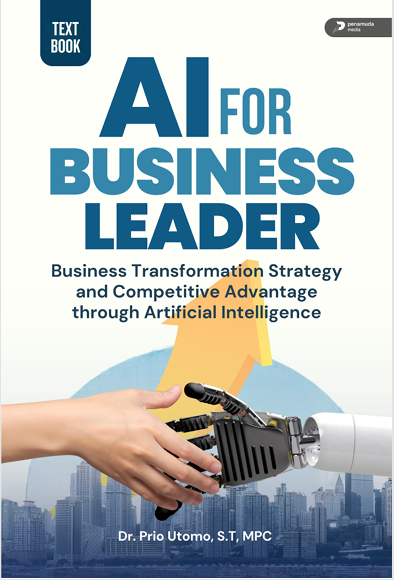
AI FOR BUSINESS LEADER BUSINESS TRANSFORMATION STRATEGY AND COMPETITIVE ADVANTAGE THROUGH ARTIFICIAL INTELLIGENCE
Rp150.000 Original price was: Rp150.000.Rp79.000Current price is: Rp79.000.
Penulis :
Dr. Prio Utomo, S.T, MPC
ISBN :
Jumlah Hlm : xiv + 169
Ukuran : 15,5 x 23 cm
Kertas : Bookpaper
Tahun Terbit : 2026
Editor : Dr. St. Hendro Budiyanto, S.Pd., M.M., CHRA
SINOPSIS
AI FOR BUSINESS LEADER Business Transformation Strategy and Competitive Advantage through Artificial Intelligence explores the strategic role of artificial intelligence (AI) in transforming business operations, decision-making, innovation, and competitive advantage. This textbook introduces the fundamental concepts of Al, machine learning, deep learning, generative Al, intelligent automation, and predictive analytics, along with their applications across business functions. It examines how Al can improve operational efficiency, enhance customer experience, support product innovation, and transform business models. The book also discusses data governance, Al ethics, organizational change management, Al agents, risk management, regulatory frameworks, and algorithmic auditing. Furthermore, it provides practical perspectives on evaluating Al project feasibility through business case analysis, communicating initiatives to stakeholders, and integrating environmental, social, and governance (ESG) considerations into Al strategies. The final chapters guide readers in developing comprehensive Al implementation plans tailored to organizational objectives and capabilities. This textbook serves as a valuable resource for students, academics, business leaders, managers, and entrepreneurs seeking to adopt Al responsibly and build sustainable competitive advantages in the digital economy.
Daftar Isi
PREFACE……………………………………………………………………………………………..iv
TABLE OF CONTENTS……………………………………………………………………… vii
HOW TO USE THIS BOOK………………………………………………………………….xi
CHAPTER 1: Foundational Concepts of Artificial Intelligence,
Machine Learning, and Generative AI in a Business Context………1
A. What Is Artificial Intelligence?……………………………………………3
B. A Brief History of AI Development: From Symbolic to
Generative ………………………………………………………………………………………4
C. The Conceptual Hierarchy: AI, Machine Learning, and
Deep Learning………………………………………………………………………………..6
D. Why AI Is a Strategic Agenda, Not Merely an IT Agenda .8
E. A Simple Framework for Evaluating Vendor AI Claims….9
CHAPTER 2: Core AI Technologies: Generative AI, LLMs,
Intelligent Automation, and Predictive Analytics ……………………… 15
A. Generative AI and Large Language Models (LLMs)……..17
B. Intelligent Automation………………………………………………………20
C. Predictive Analytics……………………………………………………………21
D. Mapping the AI Technology Portfolio to Business Needs
22
E. Assessing an Organization’s AI Maturity Level …………….22
CHAPTER 3: Opportunities for AI Application Across Business
Functions …………………………………………………………………………………………. 28
A. A Framework for Identifying AI Opportunities…………….30
B. AI Opportunities in the Operations Function………………..31
C. AI Opportunities in the Marketing Function …………………32
D. AI Opportunities in the Human Resources Function …..33
E. AI Opportunities in the Finance Function……………………..34
F. Building a Multi-Year AI Opportunity Roadmap …………..34
CHAPTER 4: The Impact of AI on Operational Efficiency and
Customer Experience …………………………………………………………………….. 40
A. Measuring the Impact of AI on Operational Efficiency..42
B. The Impact of AI on Customer Experience ……………………43
C. Balancing Efficiency and Customer Experience……………44
D. Designing an AI Impact Monitoring Dashboard……………45
CHAPTER 5: AI, Product Innovation, and Business Model
Transformation in Startups ………………………………………………………….. 50
A. Two Paths of Innovation: Sustaining versus Disruptive52
B. Three Patterns of AI-Based Product Innovation…………..52
C. AI and Startups: An Ecosystem Study …………………………….54
D. Risks and Limitations of AI-Based Innovation ……………..56
E. Assessing the Threat of AI Disruption to One’s Own
Business Model……………………………………………………………………………56
CHAPTER 6: Data Governance and AI Ethics in Implementation
Strategy ……………………………………………………………………………………………. 62
A. Why Data Governance Is the Foundation of AI
Implementation…………………………………………………………………………..64
B. Principles of AI Ethics ……………………………………………………….65
C. Developing an Organizational AI Governance Framework
67
D. Formulating a Responsible AI Usage Policy…………………..68
CHAPTER 7: Change Management for AI-Based Digital
Transformation ………………………………………………………………………………. 74
A. Why AI Adoption Often Fails Because of Human Factors,
Not Technology……………………………………………………………………………76
B. A Change Management Framework for AI Projects……..77
C. The Role of Leadership in AI-Based Transformation…..79
D. Assessing Organizational Change Readiness ………………..80
CHAPTER 8: AI Agents and Multi-Agent Systems in Business
Process Automation……………………………………………………………………….. 86
A. From Passive Generative Models to AI Agents………………88
B. Multi-Agent Systems: Collaboration Among Agents…….88
C. Business Value and Risks of AI Agents in Complex
Process Automation……………………………………………………………………90
D. Organizational Readiness for Adopting AI Agents ……….91
E. Designing Escalation and Oversight Protocols ……………..91
CHAPTER 9: Machine Learning and Deep Learning for Business
Decision-Making …………………………………………………………………………….. 97
A. Choosing the Right Approach: The Most Sophisticated
Model Is Not Always the Answer……………………………………………..99
B. The Accuracy–Interpretability Trade-off……………………….99
C. Evaluating the Quality of Prediction-Based Decisions 101
D. Build, Buy, or Subscribe: Choosing How to Acquire
ML/DL Capabilities…………………………………………………………………. 103
CHAPTER 10: Risk Management, Global Regulation, and
Algorithmic Audit………………………………………………………………………….108
A. An AI Risk Management Framework…………………………… 110
B. The Global AI Regulatory Landscape ………………………….. 111
C. Algorithmic Audit as an Accountability Mechanism … 113
D. Drafting an AI Governance Committee Charter…………. 114
CHAPTER 11: Business Case Analysis for AI Projects ……………..120
A. The Anatomy of an AI Project Business Case…………….. 122
B. Calculating Return on Investment (ROI) and Net Present
Value (NPV)………………………………………………………………………………. 122
C. Distinctive Challenges in Measuring the Benefits of AI
Projects……………………………………………………………………………………… 124
D. Sensitivity Analysis in an AI Business Case ……………….. 125
CHAPTER 12: Strategic Communication and Presenting AI
Projects to Stakeholders ………………………………………………………………131
A. Understanding Stakeholders and Their Interests …….. 133
B. Narrative Structure for an Effective Business Case
Presentation …………………………………………………………………………….. 134
C. Data Visualization and the Use of AI in the
Communication Process Itself………………………………………………. 135
D. Managing a Critical Question-and-Answer Session….. 136
CHAPTER 13: Sustainable AI: Environmental, Social, and
Governance (ESG) Dimensions…………………………………………………….142
A. The Environmental Footprint of AI Technology ……….. 144
B. Social Impact: Inequality and Inclusion……………………… 145
C. AI as a Tool for Advancing ESG Objectives …………………. 147
D. Establishing Sustainable AI Performance Indicators.. 148
CHAPTER 14: Developing a Comprehensive AI Implementation
Plan for an Organization………………………………………………………………155
A. Why Integration, Not Merely the Sum of the Parts …… 157
B. A Template for a Comprehensive AI Implementation
Plan157
C. Characteristics of a Realistic Implementation Plan for
the Startup Context…………………………………………………………………. 160
D. Common Pitfalls in AI Implementation Plans and How to
Avoid Them………………………………………………………………………………. 161
ABOUT THE AUTHOR…………………………………………………………………….167
Produk Serupa
Related products
-
Sale!

MANAJEMEN PROYEK PERANGKAT LUNAK
Rp98.000Original price was: Rp98.000.Rp80.000Current price is: Rp80.000. -
Sale!
KEAMANAN SISTEM INFORMASI
Rp98.000Original price was: Rp98.000.Rp80.000Current price is: Rp80.000. -
Sale!
METODE STEAMMI UNTUK PENGEMBANGAN POTENSI PESERTA DIDIK
Rp98.000Original price was: Rp98.000.Rp80.000Current price is: Rp80.000. -
Sale!

MANAJEMEN PENDIDIKAN
Rp98.000Original price was: Rp98.000.Rp80.000Current price is: Rp80.000. -
Sale!
PENGANTAR ILMU KIMIA
Rp98.000Original price was: Rp98.000.Rp80.000Current price is: Rp80.000. -
Sale!

E-COMMERCE
Rp98.000Original price was: Rp98.000.Rp80.000Current price is: Rp80.000.